


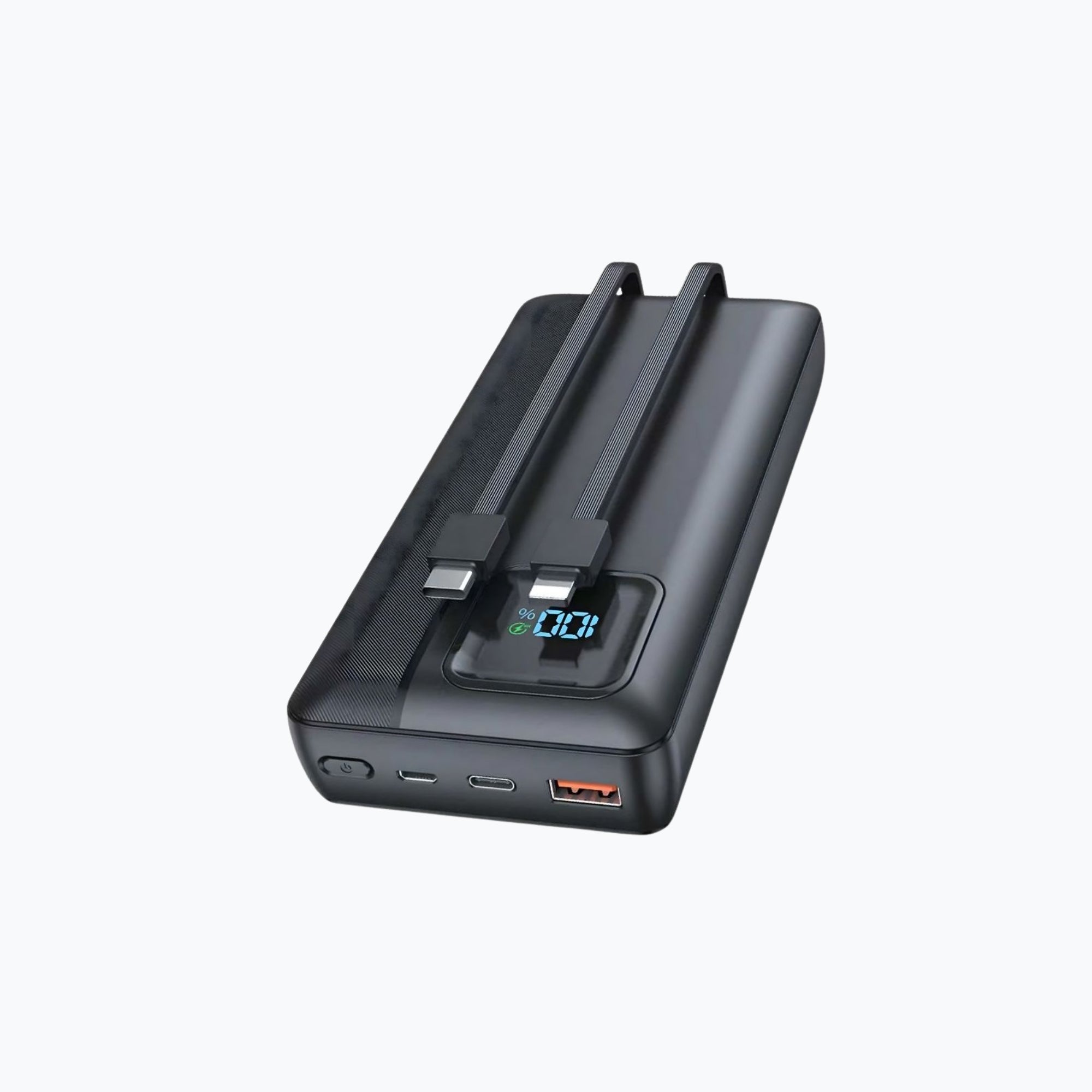

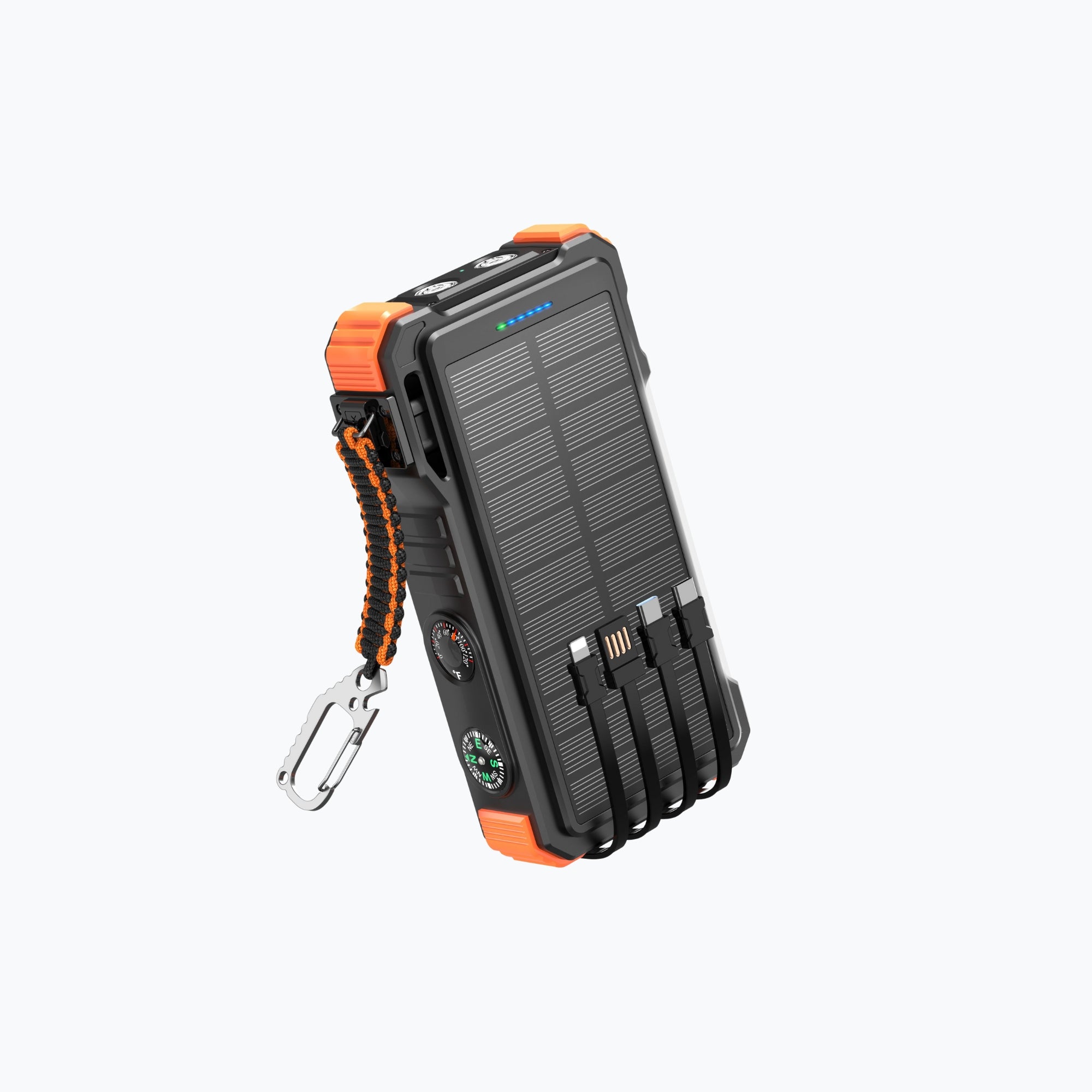
Solar Powerbanks (with solar panel)
A solar power bank is handy when you don't want to be dependent on outlets. Solar charging keeps your devices powered, even during outdoor use or long days on the road. Siltcon's solar power banks combine high capacity with wireless charging and a robust casing, ensuring reliability in varying conditions. Ideal for travel, camping, or simply needing extra security outdoors.
Frequently asked questions about (our) solar power banks with solar panel
What is a solar power bank and when do people choose it
A solar power bank is a power bank with a built-in solar panel. This allows you to charge the power bank not only via an outlet or USB connection but also using sunlight. This makes this type of power bank especially interesting at times when you’re not sure if you’ll always have access to power. Think camping, festivals, hikes, road trips, outdoor vacations, home emergencies, or simply long days on the go.
The biggest difference with a regular power bank is not just the solar panel itself, but especially the extra security you get. A standard power bank works perfectly as long as it’s fully charged beforehand. A solar power bank also gives you an extra way to get energy if your plans change unexpectedly or when charging via the outlet isn’t possible for a while.
A solar power bank is especially a good choice if you recognize yourself in one or more of the following situations
-
You’re regularly outdoors and don’t want to depend on a single charging moment
-
You often use navigation, camera, music, or a flashlight on the go
-
You want a reliable power bank as part of an emergency kit
-
You travel a lot and want a backup for hotels, airports, and long travel days
It’s important to know that solar charging is a supplement. It’s not a replacement for USB charging if you want to fully charge the power bank quickly.
Does solar charging really work and what can you realistically expect from it
Charging with solar energy definitely works, but it’s important to have realistic expectations. Solar charging is most effective in direct sunlight, with a good panel position facing the sun, and enough time. This makes it ideal for topping up on the go and maintaining your power bank’s energy level.
What is usually less realistic is fully charging an empty power bank within one afternoon using only sunlight. Therefore, see solar charging mainly as a way to add extra energy and prevent your power bank from running completely empty.
This is how you get the most out of solar charging
-
Place the solar panel in direct sunlight and not behind glass
-
Point the panel as directly as possible towards the sun
-
Avoid shade, even small shadows can greatly reduce output
-
Give it time and use solar charging as a supplementary charge during the day
For many users, the real benefit lies in the combination. You start with a fully charged power bank and use the solar panel to top up capacity on the go.
Which solar power bank suits me best, 20000 mAh or 30000 mAh
The choice between a 20000 mAh and 30000 mAh solar power bank is mainly a trade-off between compactness and extra energy reserve.
A 20000 mAh solar power bank suits you if..
-
You’re looking for a reliable power bank for day trips, weekend getaways, and festivals
-
You prefer a slightly more compact and lighter size
-
You usually want to charge one or two devices at the same time
-
Fast charging via USB-C is important to you
A 30000 mAh solar power bank suits you better if..
-
You take longer trips or are off-grid for several days in a row
-
You regularly want to charge multiple devices, also for others
-
You want to use the power bank consciously as emergency power
-
You want extra margin so you don’t have to worry as much about remaining capacity
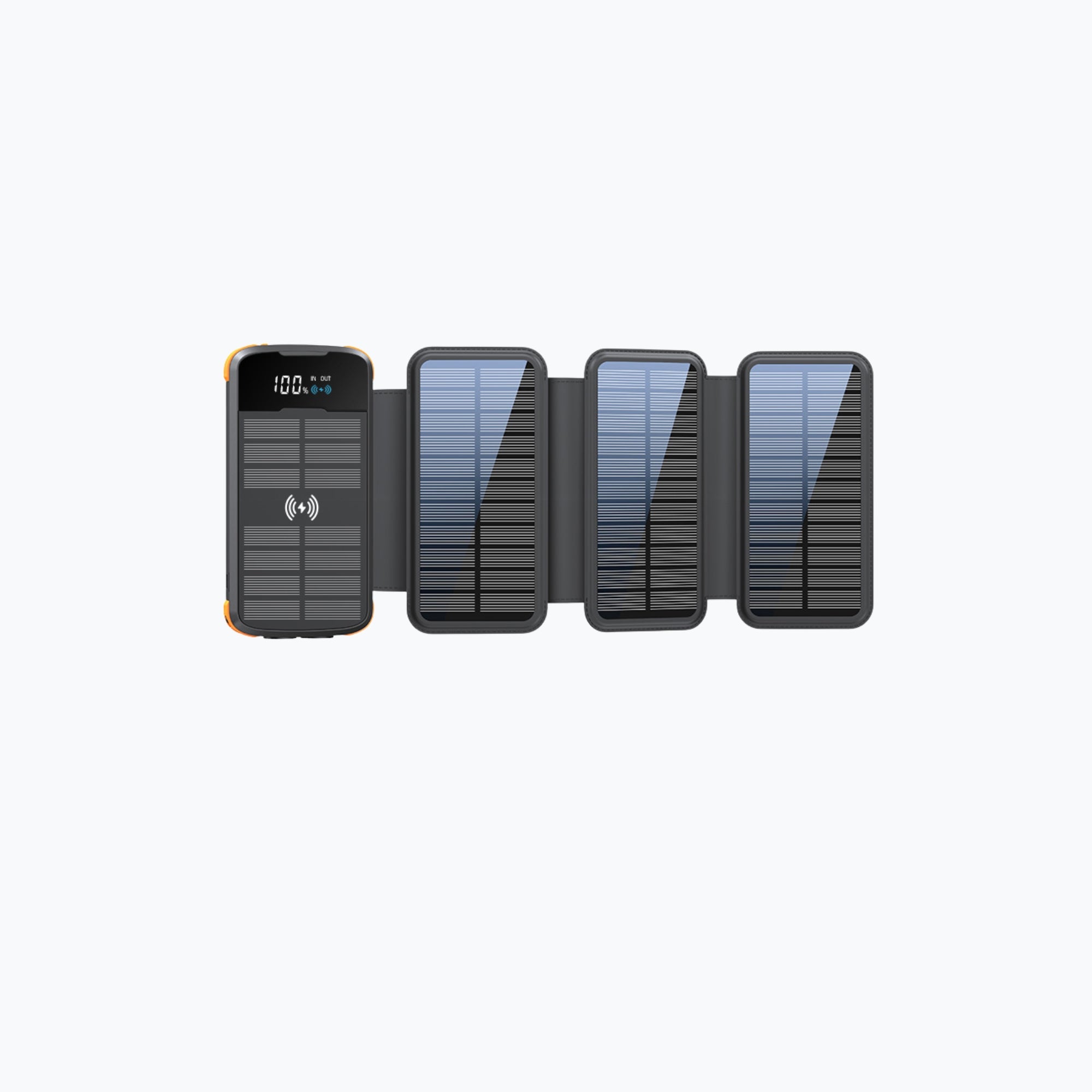
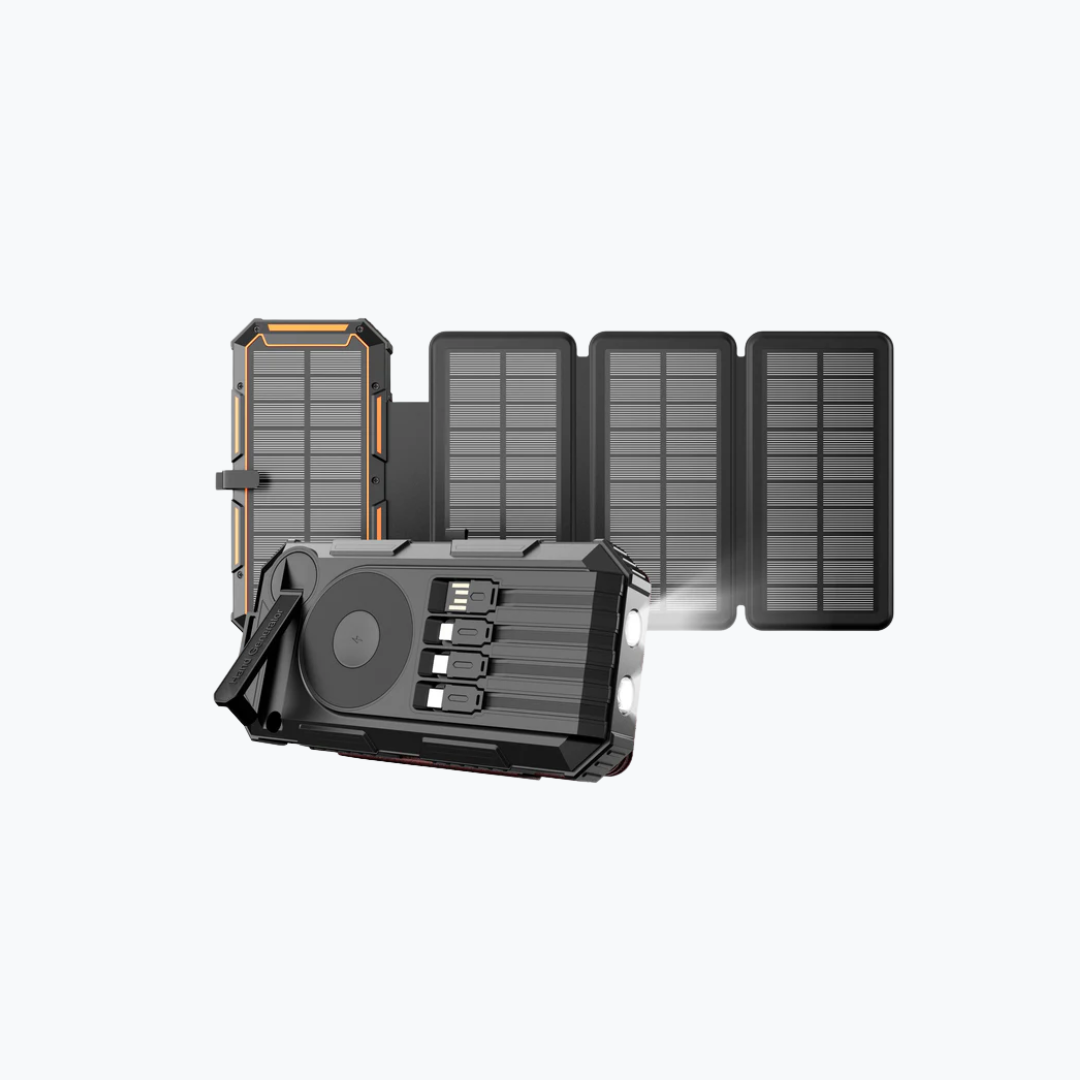
For example, the product page of the 30000 mAh version mentions that this model has four solar panels and a comprehensive design that allows multiple devices to be charged simultaneously. The 20000 mAh version emphasizes fast USB-C charging, wireless charging, and extra outdoor features.
How often can I charge my phone with a solar power bank
How often you can charge your phone depends on several factors
-
The capacity of your phone’s battery
-
Charging loss, which always occurs with power banks
-
The charging method, with cable or wireless
In practice, some energy is always lost due to voltage conversion and heat. That’s why it’s wise not to rely on the maximum capacity on paper.
Here’s how to make a realistic estimate
-
Assume a smartphone battery of about 4000 to 5000 mAh
-
Keep in mind losses, so you never use the full power bank capacity
-
With 20000 mAh you can expect multiple full charges in many situations
-
With 30000 mAh you have more capacity and can go longer, even when charging other devices
Wireless charging is slightly less efficient than charging with a cable. For maximum efficiency, a cable is usually the best choice, while wireless charging is mainly about convenience.
Can I charge multiple devices at the same time?
Yes, these solar power banks are designed to charge multiple devices at the same time. This can be done via different ports and, depending on the model, also via wireless charging.
Keep the following in mind
-
If charging speed is important, it’s best to charge one device at a time via USB-C
-
When charging multiple devices at the same time, the power is divided, which can make charging a bit slower
-
Wireless charging is convenient as an extra option, for example alongside a device you charge with a cable
A practical approach is to top up your phone during the day and fully recharge the power bank itself once you have access to power in the evening. This way, you prevent everything from running out at the same time.
What is the difference between charging via USB-C and wireless charging
Charging via USB-C is usually the fastest and most efficient, especially if your device supports fast charging. This is the best choice when you want to charge your phone or tablet as quickly as possible.
Wireless charging is mainly about convenience. You place your phone on the charging surface and it charges, as long as your device is Qi-compatible. Keep in mind that wireless charging is slightly less efficient and can therefore be a bit slower.
When to choose which option
-
USB-C when speed and efficiency are important
-
Wireless charging when you want convenience and don’t have a cable handy
For a stable wireless charging experience, it is recommended to place your phone centrally on the charging surface and remove thick cases or metal accessories.
How long does charging via sun take and how long does charging via cable take
Charging via sunlight depends heavily on factors like (natural) sunlight strength, panel angle, temperature, and whether you are charging devices at the same time. Solar charging is therefore mainly suitable as a top-up.
Charging via a cable is the fastest way to get your power bank fully ready for use again. This is ideal at home, in the car, or places where you have access to power.
A useful routine is always to go out with a fully charged power bank and use the solar panel to add extra energy on the go.
Are solar power banks suitable for camping, festivals, and emergency kits
Solar power banks are ideal for camping, festivals, outdoor activities, and emergency situations. You carry a large capacity, can charge multiple devices, and have an extra charging option via sunlight.
In addition, these power banks often have handy extras like a built-in flashlight and an SOS mode, which can be especially valuable in the dark or emergencies.
For a complete emergency kit, it’s smart to think not only of the power bank but also a charging cable you actually use, an adapter for home or car, and a fixed place where you store and regularly check the power bank.
How water-resistant and shockproof are these solar power banks
These solar power banks are designed with outdoor use in mind and are described as rugged, water-resistant, and shockproof. This means they are well protected against rain, dust, sand, and the minor bumps that are almost inevitable during travel, camping, or daily use on the go.
Water-resistant means in practice that rain, wet grass, or a humid environment are not a problem. However, it does not mean the power bank is completely waterproof. Submerging it underwater or prolonged exposure to a lot of moisture is therefore not recommended. The connections especially remain a point of attention.
Here’s how to handle it wisely:
-
Make sure to close all ports properly when using the power bank outdoors
-
Do not leave it unnecessarily in wet conditions
-
Dry the power bank before putting it back in your bag
The shock resistance ensures that a fall or bump usually does not cause immediate damage. This makes these power banks suitable for active situations like hiking, cycling, festivals, and outdoor vacations. Common sense remains important. Avoid hard impacts and store the power bank safely when not in use.
Which cables and connectors are built-in, and do I still need separate cables
These solar power banks are designed for convenience on the go and therefore feature multiple built-in cables and connectors. This allows you to charge directly in many situations without first having to find or carry separate cables.
In practice, this means you almost always have a suitable connector for your smartphone or other device with you. This is especially convenient during travel, festivals, or outdoor activities, where you don’t want to carry everything all the time.
Still, it can be smart to bring one extra cable:
-
If you also use a tablet, e-reader, or other device with a specific connector
-
If you want faster charging with your own cable that supports fast charging
-
If you want to charge multiple devices at the same time without relying on the built-in cables
Think of the built-in cables as convenience and assurance. A separate cable is mainly an extra backup for specific situations.
Can I charge the power bank while charging my phone
In many cases, it is technically possible to charge the power bank while simultaneously charging a device. This is called pass-through charging. Although possible, it is not always the most efficient way to charge.
When you have access to power, it usually works better to fully charge the power bank first and then your devices. This way, you make optimal use of the charging capacity and avoid unnecessary energy loss.
There are situations where charging simultaneously can be convenient
-
In emergency situations where you have only one power source
-
When you have short access to power and need quick availability
-
If you mainly charge slowly and speed is less important
Keep in mind that charging in this situation often takes longer because the power is divided between the power bank and the connected device.
Are solar power banks safe for all my devices
These solar power banks are equipped with multiple built-in protections designed to safeguard both the power bank itself and your connected devices. This includes protection against overheating, overvoltage, short circuits, and overload.
In practice, this means you can safely charge your phone, tablet, or accessories, even during longer sessions. Especially for outdoor use, this is reassuring because conditions like heat and sunlight can add extra strain.
In addition, you can contribute to safe use by:
-
Preferably use quality cables suitable for your device’s power
-
Do not unnecessarily place your phone and power bank in direct sunlight while charging
-
Place the power bank on a stable surface when charging quickly
By following these simple guidelines, you not only extend the lifespan of your devices but also that of the power bank itself.
Is a solar power bank allowed on the plane ▸
In many cases, a solar power bank is allowed on the plane, provided it is carried in the carry-on luggage. Power banks are generally not allowed in checked baggage due to safety regulations concerning lithium batteries.
Exact conditions may vary by airline, for example regarding maximum capacity or the number of power banks you may bring. It is therefore always wise to check this in advance.
Practical tips for traveling with a power bank
-
Always carry the power bank in your carry-on luggage
-
Turn off the power bank during transport
-
Make sure the connections are not accidentally activated in your bag
This way you avoid surprises at security checks and can travel worry-free with your power bank.
Which extra features make these solar power banks suitable for outdoor use
Besides capacity and solar charging, these solar power banks have extra features that add a lot of value especially outdoors. These features are designed to make you more independent and better prepared during travel and outdoor activities.
Examples of practical extras
-
A built-in LED flashlight for use in the dark
-
An SOS mode for emergencies
-
Displays that let you see at a glance how much energy you have left
These features come in handy during camping, evening walks, festivals, and situations where you don’t have other tools at hand. They make the power bank more than just a charger, but also a useful tool in the field.
How do I maintain my solar power bank to make it last as long as possible
Proper maintenance greatly affects the lifespan of your solar power bank. With a few simple habits, you ensure it remains reliable, even if you don’t use it daily.
Practical maintenance tips
-
Preferably store the power bank at room temperature
-
Do not leave it for extended periods in a hot car or in direct sunlight
-
Recharge the power bank occasionally if you don’t use it for a long time
-
Keep the solar panel clean so it can absorb sunlight optimally
A handy habit is to periodically check the battery level, for example once a month or every quarter. This way, you can be sure the power bank is ready for use when you need it.

Discover our story
Siltcon grew from a hobby into a close-knit team with one goal: making useful technology accessible to everyone.
Read moreTrusted by Our Partners